Water is one of life’s few absolute necessities. We can postpone buying a new car, delay a vacation, or even skip a meal now and then, but our bodies cannot function for long without safe drinking water. Ironically, clean water is also one of the things we think about the least. Turn on the kitchen faucet, fill a glass, and drink. It’s a routine repeated billions of times every day with almost no thought. In developed countries, most people assume the water coming from the tap is safe. They don’t pause to consider the complex network of reservoirs, treatment plants, pumps, pipelines, testing laboratories, and skilled professionals working around the clock to make that confidence possible.
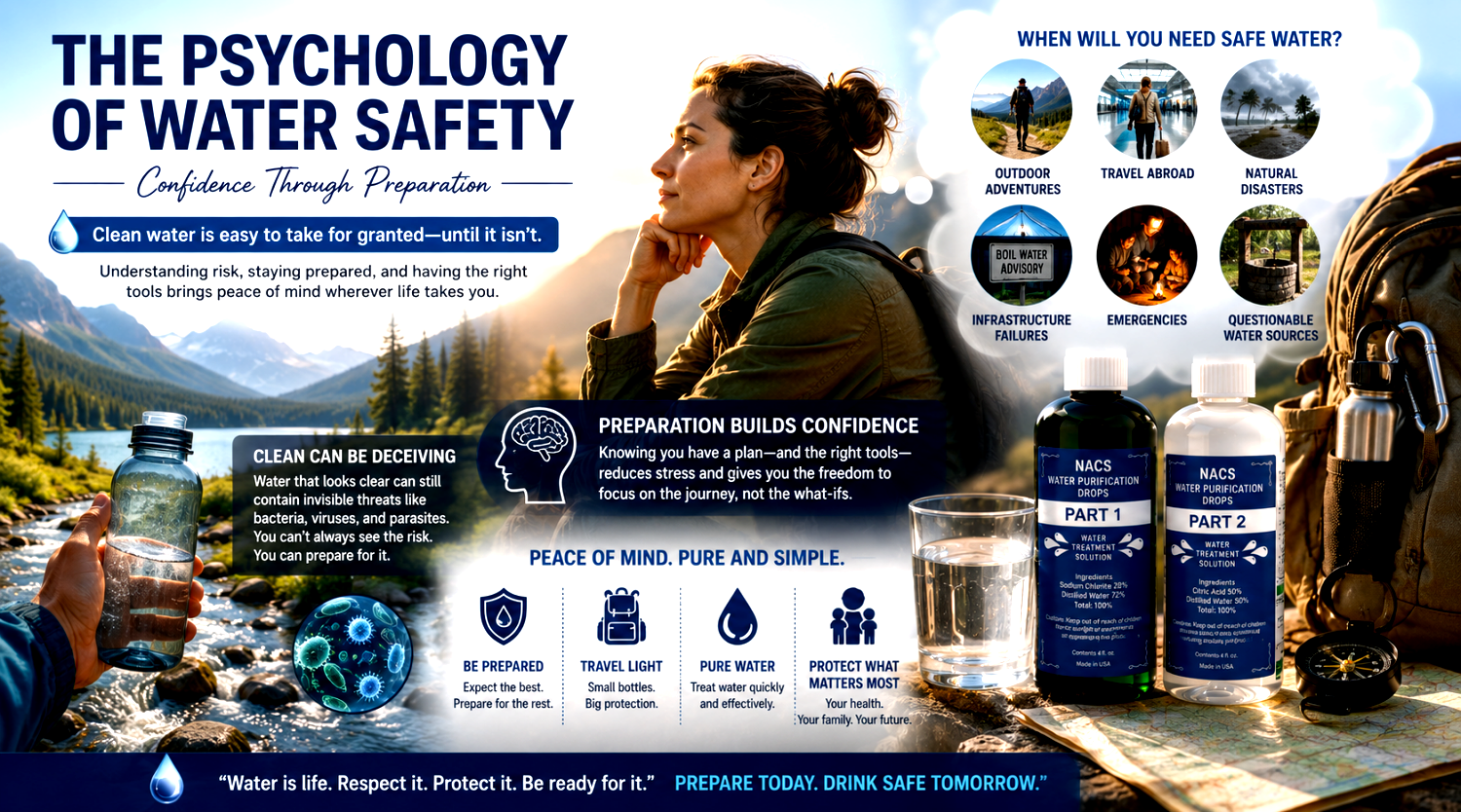
Water safety has become invisible because, most of the time, it works. That invisibility changes the moment something goes wrong.
The Moment Confidence Disappears
Nearly everyone has experienced one of these moments.
- A boil-water advisory appears on the evening news.
- A hurricane knocks out the local treatment plant.
- Floodwaters contaminate private wells.
- An earthquake ruptures underground water lines.
- You’re hiking miles from civilization with only a mountain stream nearby.
- You’re visiting another country where local residents drink the tap water comfortably—but visitors often don’t.
Suddenly, water is no longer something you simply drink. It becomes something you must evaluate.
- Is it safe?
- Where did it come from?
- What could be living in it?
- How do I know?
The psychology changes instantly—from confidence to uncertainty.
Crystal-Clear Doesn’t Mean Clean
One of the biggest misconceptions about drinking water is that danger should be visible. We naturally trust what looks clean.
- A clear mountain stream winding through alpine meadows feels pure.
- A sparkling lake reflects blue skies.
- A cool glass of water looks refreshing.
Unfortunately, appearance alone tells us very little about microbiological safety.
Many organisms capable of causing illness are invisible to the naked eye. Water can appear perfectly clean while containing bacteria, viruses, or protozoa that cannot be seen, smelled, or tasted. This disconnect between appearance and reality is why experienced outdoor enthusiasts learn to evaluate water differently than casual observers. They understand that clear water and safe water are not always the same thing.
Why Travelers Get Sick
International travel provides another fascinating example of water psychology. Many travelers assume they are eating carefully while overlooking the water used to prepare food, wash produce, make ice, or brush their teeth.
In many parts of the world, local residents may tolerate microorganisms that visitors have never encountered. Their bodies have adapted through long-term exposure, while travelers have not.
That doesn’t necessarily mean the local water is “bad.” It simply means that different populations may respond differently to unfamiliar microorganisms. For this reason, many experienced international travelers carry portable water purification products as one part of their travel preparedness.
Their goal isn’t fear. It’s confidence.
The Preparedness Mindset
Preparedness isn’t about expecting disasters. It’s about reducing uncertainty. We routinely prepare for situations that may never occur.
- We wear seat belts.
- Carry spare tires.
- Purchase insurance.
- Install smoke detectors.
- Pack first-aid kits.
- Charge our phones before long trips.
Most of these precautions are never needed. Yet we feel better knowing they’re available.
Portable water purification fits into this same category. It occupies very little space, weighs very little, and may never be used. But when clean drinking water becomes uncertain, having options can provide tremendous peace of mind.
The Difference Between Panic and Preparation
People often imagine emergencies as dramatic, movie-like events. The reality is usually much quieter.
- A broken water main.
- A campground without treated water.
- An unexpected overnight delay.
- A hiking trail that takes longer than expected.
- A severe storm.
- A temporary boil-water notice.
These situations rarely make national headlines. Yet they happen somewhere every day.
Preparation doesn’t eliminate uncertainty. It reduces dependence upon it.
Confidence Travels Well
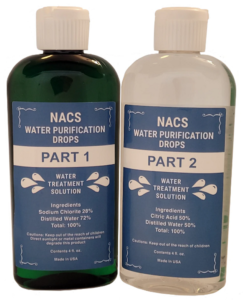
One reason chlorine dioxide water purification drops have remained popular among campers, backpackers, humanitarian workers, missionaries, hunters, outdoor professionals, and international travelers is their simplicity.
Small bottles fit easily into a backpack, suitcase, glove compartment, or emergency kit.
When needed, they provide an option for treating water from questionable sources according to the product instructions.
For many users, that option represents something larger than water treatment. It represents confidence. The confidence to continue the journey. The confidence to explore farther. The confidence to adapt when plans change.
Water Is More Than Hydration
Water connects nearly every part of life.
- Cooking.
- Cleaning.
- Travel.
- Adventure.
- Family emergencies.
- Natural disasters.
- Health.
- Work.
- Recreation.
Because we depend upon it constantly, we rarely appreciate how vulnerable that dependence can become until circumstances change.
Perhaps the greatest value of water preparedness is not fear of what might happen. It is the freedom that comes from knowing you have prepared thoughtfully.
The Psychology of Confidence
Psychologists have long observed that uncertainty creates stress. People naturally seek ways to reduce uncertainty—not necessarily by eliminating risk, but by increasing confidence in their ability to respond. Preparedness accomplishes exactly that.
- Knowing you have emergency food reduces anxiety.
- Knowing you have flashlights during a power outage provides reassurance.
- Knowing you have clean water options can offer similar peace of mind.
The equipment itself may be small. The confidence it provides can feel much larger.
Clean drinking water is one of modern society’s greatest achievements, and for most of us it is available every day with little thought. Yet history has repeatedly shown that circumstances can change—whether through travel, severe weather, infrastructure failures, or unexpected detours.
The psychology of water safety isn’t about becoming fearful or suspicious of every glass of water. It’s about becoming aware. Awareness leads to preparation. Preparation leads to confidence. And confidence allows us to keep exploring, traveling, working, and living with one less uncertainty to worry about.
Perhaps the greatest benefit of carrying water purification drops is not simply that they may help make questionable water suitable for drinking according to their instructions. It’s that they allow us to focus less on worry—and more on the journey ahead.
Leave a Reply