When people begin preparing for outdoor adventures, international travel, or emergency situations, one question almost always comes up: Should I carry a water filter or water purification drops? The answer isn’t as simple as declaring one better than the other. Both have strengths. Both have limitations. The best choice often depends on where you’re going, how much water you’ll need, and what kinds of microorganisms may be present. For many experienced campers, backpackers, humanitarian workers, and international travelers, the ideal solution isn’t choosing one over the other; it’s understanding when each tool works best.
Understanding the Difference
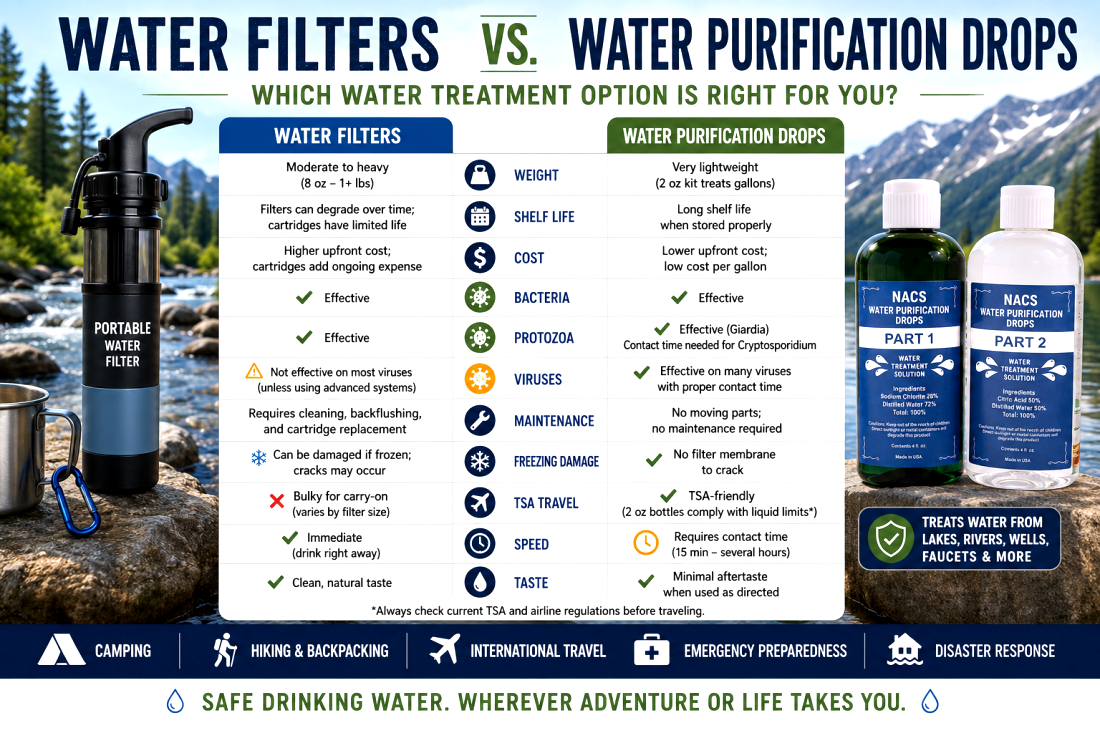
Although the terms are often used interchangeably, water filtration and water purification are different processes.
A water filter physically removes contaminants by forcing water through microscopic pores or filtering media.
Water purification drops, when used according to their directions, work chemically by inactivating or neutralizing many disease-causing microorganisms in water.
Each approach offers advantages depending on the situation.
Weight: Every Ounce Matters
For backpackers and hikers, weight is always a consideration.
Most portable water filters weigh anywhere from several ounces to over a pound, depending on their design and capacity.
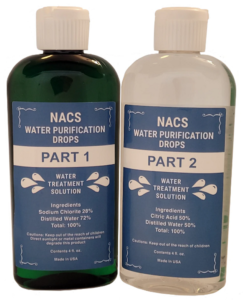
By comparison, a two-bottle chlorine dioxide water purification kit is compact and lightweight, fitting easily into a backpack, emergency kit, glove compartment, or travel bag.
For travelers trying to minimize luggage, the small size of water purification drops can be especially appealing.
Shelf Life
Another consideration is long-term storage.
Mechanical filters may require replacement cartridges, seals, or maintenance after extended storage or repeated use.
Water purification drops, when stored according to the manufacturer’s recommendations, are often chosen for emergency preparedness because they occupy very little space and do not rely on replaceable filter elements.
For families assembling emergency kits, compact storage can be an important advantage.
Cost
The total cost of ownership can vary considerably.
A quality water filter often requires a larger initial investment, and replacement cartridges may add ongoing expense over time.
Water purification drops typically involve a lower upfront cost, though the cost per treated gallon depends on the specific product and how frequently it is used.
For occasional travelers or emergency preparedness, many people appreciate having an inexpensive backup option available.
Protection Against Bacteria
Most quality backpacking filters are designed to remove bacteria commonly found in natural water sources.
Chlorine dioxide water purification drops are also widely used to inactivate many harmful bacteria when used according to product directions.
Both approaches can be effective when used properly.
Protozoa
Protozoan parasites such as Giardia and Cryptosporidium are common concerns in untreated surface water.
Many backpacking filters are specifically designed to remove these larger organisms.
Chlorine dioxide is also recognized for its effectiveness against Giardia. Some protozoa, such as Cryptosporidium, require longer contact times than many bacteria or viruses, making it important to follow the manufacturer’s instructions carefully for the water being treated.
Viruses
This is one of the biggest differences between many portable filters and water purification drops.
Because viruses are much smaller than bacteria or protozoa, many standard backpacking filters are not designed to remove viruses unless they include additional purification technologies.
Chlorine dioxide is commonly used for emergency water treatment because it can inactivate many viruses when used according to the product instructions and with appropriate contact times.
For international travel or disaster situations where viral contamination is a concern, this distinction is often an important consideration.
Maintenance
Every piece of equipment eventually needs care.
Water filters may require:
- cleaning
- backflushing
- cartridge replacement
- protection from clogging
- seal maintenance
Water purification drops have no moving parts, no pump mechanisms, and no filter cartridges to maintain.
That simplicity is one reason many experienced travelers keep them as a backup even when carrying a filter.
Freezing Temperatures
Freezing conditions create another important difference.
If water trapped inside many mechanical filters freezes, tiny cracks can develop in the filter element.
Those cracks may not be visible, but they can reduce the filter’s effectiveness.
Water purification drops generally do not have fragile filter membranes that can be damaged in this way, although they should still be stored according to the manufacturer’s recommendations.
For winter camping or cold-weather travel, this may influence equipment choices.
TSA-Friendly Travel
International travelers often appreciate equipment that packs easily.
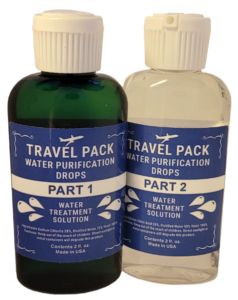
Many travel-sized two-part water purification drop kits are packaged in small bottles that comply with common carry-on liquid size limits, making them convenient for airline travel. Travelers should always verify current TSA and airline requirements before flying.
Bulky filters, while certainly portable, occupy more luggage space.
For frequent travelers, compact size can be a meaningful advantage.
Speed
When thirst strikes, time matters.
Many portable filters provide treated water almost immediately after filtering.
Water purification drops require a waiting period so the solution has time to work. The required contact time varies depending on water temperature, clarity, and the types of microorganisms being addressed, so users should always follow the product directions.
The tradeoff is simple:
- Filters provide water immediately after filtration.
- Purification drops require patience but can address microorganisms that many basic filters are not designed to remove.
Taste
Taste is largely a matter of personal preference.
Some people enjoy the clean, neutral taste produced by high-quality filters.
Others find that chlorine dioxide leaves relatively little aftertaste compared with some other chemical disinfectants when used as directed.
Water source quality also plays an important role in overall taste.
Side-by-Side Comparison
| Feature | Water Filters | Water Purification Drops |
| Weight | Moderate | Very lightweight |
| Shelf Storage | May require cartridge care | Compact and easy to store |
| Initial Cost | Usually higher | Usually lower |
| Bacteria | ✔ Commonly addressed | ✔ Commonly addressed |
| Protozoa | ✔ Commonly addressed | ✔ Commonly addressed (contact time varies) |
| Viruses | Often not addressed by basic filters | ✔ Commonly addressed when used as directed |
| Maintenance | Cleaning and replacement parts | No moving parts |
| Freezing | Some filters may be damaged | No filter membrane to crack |
| Air Travel | Larger equipment | Compact travel-sized kits available |
| Speed | Immediate | Requires contact time |
| Taste | Filtered taste | Often minimal aftertaste compared with some disinfectants |

Why Many Experienced Travelers Carry Both
Rather than viewing filters and water purification drops as competitors, many experienced outdoor enthusiasts see them as complementary tools.
A filter can quickly remove sediment and many microorganisms from clear streams and lakes.
Water purification drops can serve as a lightweight backup, help treat microorganisms that basic filters may not address, or be used when carrying a filter isn’t practical.
Choosing the right tool depends on your destination, the quality of available water, and your personal travel style.
Final Thoughts
Safe drinking water is one of the most important parts of any outdoor adventure, emergency plan, or international journey.
Whether you choose a water filter, water purification drops, or a combination of both, understanding how each method works can help you make informed decisions before you ever need them.
For many travelers, preparedness isn’t about carrying more gear.
It’s about carrying the right gear for the situation.
Educational Notice
This article is intended for educational and informational purposes only. Water treatment products should always be used according to the manufacturer’s instructions. No single method is appropriate for every situation or every water source. Users should understand the capabilities and limitations of their chosen equipment and follow applicable public health guidance when treating drinking water.
Leave a Reply